The hidden emotional weight of dog guardianship
One of the most common questions I’m asked by colleagues is, “What’s your speciality?”
My answer is almost always the same: nervous system focused work—for both dogs and their guardians.
Because behaviour never exists in isolation.
Over the years, I have worked with countless dogs and their families, and one thing has become overwhelmingly clear: supporting the dog often means supporting the human too. The guardian often becomes the emotional anchor for the dog, and sometimes the professional becomes the anchor for them both.
When we truly get to know guardians, we begin to understand that they carry their own histories too. Trauma. Anxiety. Burnout. Disability. Grief. Financial pressure. Relationship strain. Unrealistic expectations. Shame. Chronic stress. Loneliness.
All of these things can influence how someone raises their dog, interprets behaviour, responds to stress, and seeks help.
Yet from the outside, it can be incredibly easy for people to judge.
To form opinions with very little context.
To see only the behaviour, not the biology behind it. Not the environment. Not the nervous system. Not the emotional exhaustion underneath it all.
One of the most common themes I encounter within dog–human relationships is isolation, hopelessness, sadness, guilt, and emotional fatigue. This emotional side of dog guardianship is rarely discussed openly, despite how profoundly common it is.
I have sat with guardians who have cried because they believed they had failed their dog. Guardians who felt embarrassed, ashamed, overwhelmed, or terrified of being judged. People who deeply loved their dogs but felt they were somehow “not good enough.”
And what strikes me most is that these are rarely careless people.
They are often the people trying the hardest.
The people researching at 2am. The people cancelling plans. The people walking at quieter times. The people spending money they do not really have. The people rearranging their lives around triggers, routines, medication schedules, enrichment, recovery plans, decompression, and management.
The people carrying guilt silently.
As professionals, we may know that this guilt is often misplaced—but the emotion itself is still very real.
We cannot simply tell someone not to feel guilty. What we can do is recognise the emotion, validate it, and support that person with kindness and education, just as we would support a frightened or overwhelmed dog.
That matters.
Because asking for help with a beloved dog can feel incredibly vulnerable. For many guardians, it feels similar to a parent admitting they are struggling.
And there is something else we do not talk about enough:
Sometimes loving your dog feels heavy.
Not because you do not love them. Not because you resent them. Not because you are a bad guardian.
But because caregiving itself can become emotionally exhausting when layered with chronic stress, fear of judgement, isolation, lack of support, unrealistic expectations, and nervous system overload.
Many guardians live in a constant state of hypervigilance.
Watching the environment. Scanning for triggers. Changing walking routes. Avoiding visitors. Closing curtains. Apologising repeatedly for their dog’s behaviour. Preparing for reactions before they have even happened.
Some guardians stop inviting people to their homes entirely. Some avoid holidays. Some stop going out socially. Some feel unable to leave the house without anxiety. Others begin walking their dogs very early in the morning or very late at night because they fear criticism from others.
And perhaps the saddest sentence I hear repeatedly is:
“I wish people could see how lovely they are at home.”
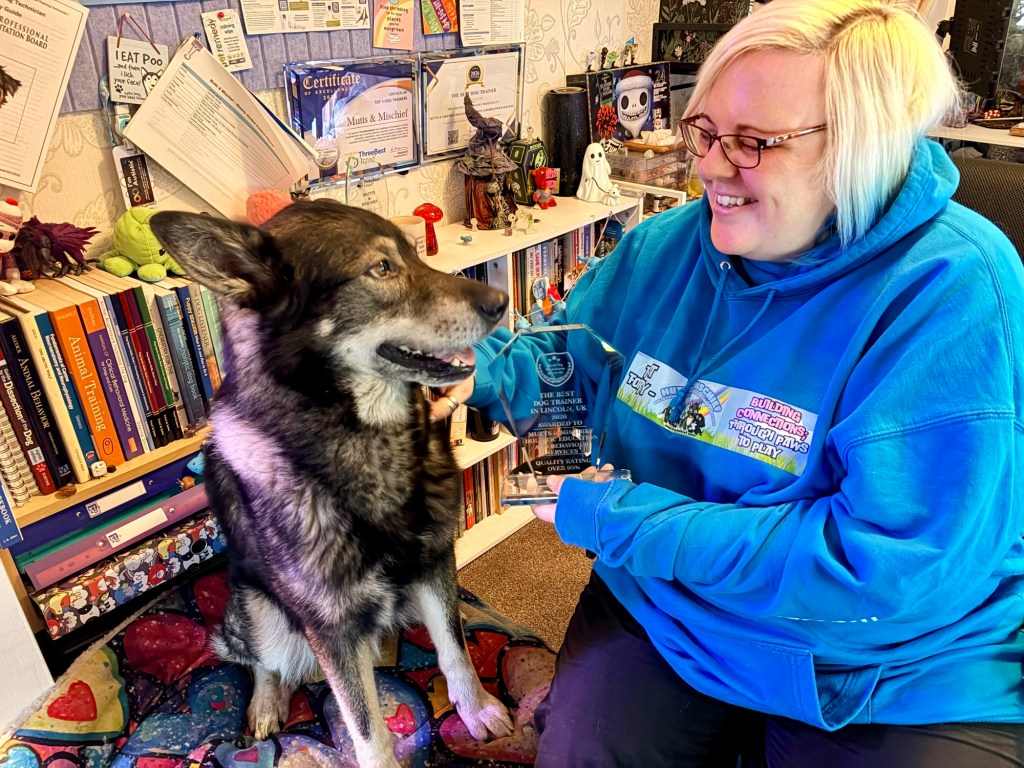
Because often, behind closed doors, away from pressure and overwhelm, these dogs are soft. Affectionate. Funny. Playful. Deeply connected to their humans.
Many guardians feel as though they are living two entirely different realities:
- the dog the world sees,
- and the dog they know intimately at home.
This emotional conflict can become incredibly painful.
We know from research that dogs form strong attachment relationships with humans. Studies based upon Attachment Theory have demonstrated that dogs use guardians as both a secure base and a safe haven during stressful situations (Palmer & Custance, 2008; Gácsi et al., 2013).
Research using fMRI imaging found increased activity within the canine caudate nucleus—a reward processing area of the brain—when dogs heard their guardians’ voices, particularly during praise and positive social interaction (Andics et al., 2019).
Dogs are not simply responding to noise.
They are neurologically responding to emotionally significant individuals.
And humans respond too.
Increasingly, research suggests that dogs and guardians influence one another emotionally through processes often described as emotional contagion and social synchronisation. Sundman et al. (2019) found correlations between long-term cortisol levels in dogs and their guardians, suggesting stress states may become interconnected over time.
Sometimes I picture this relationship almost like a seesaw.
Both beings carrying stress and anxiety. Both trying to regulate alongside one another. Both imperfect. Both overwhelmed at times. Yet simultaneously helping one another feel loved, needed, and safe.
There is often a beautiful synchronicity within these relationships that outsiders do not see.
And society does not make this easier.
Humans are naturally comparative creatures. We compare ourselves constantly—to social media, television, polished training videos, strangers at the park, and curated snapshots of other people’s lives.
Many guardians have told me:
- “I think my dog likes my partner more.”
- “I feel like everyone else has this figured out.”
- “My dog deserves better than me.”
- “I think I’ve ruined them.”
- “I dread walks.”
- “I feel trapped.”
- “I don’t think my dog even loves me.”
These thoughts are far more common than people realise.
The “puppy blues” are also very real. Haraguchi (2021) discusses the emotional distress many guardians experience following the arrival of a puppy, including overwhelm, regret, anxiety, panic, sleep deprivation, and low mood. While not formally classified as a mental health diagnosis, the experience is increasingly recognised by both behaviour and mental health professionals.
And these emotions do not necessarily disappear after puppyhood ends.
Guardians can experience chronic guilt and emotional exhaustion throughout their dog’s life, particularly when living with:
- reactivity,
- separation-related distress,
- chronic health conditions,
- trauma histories,
- aggression cases,
- or dogs requiring significant management.
Part of this emotional weight comes from unrealistic expectations.
Dogs are not robots. They are not blank slates. They are complex individuals with genetics, emotions, nervous systems, learning histories, sensory processing differences, preferences, and species-specific behavioural needs.
Genetics alone play a significant role in behaviour. Breed-related behavioural traits have repeatedly been linked to inherited genetic markers (Starling, 2022).
Humans have selectively bred dogs for thousands of years for specific purposes—guarding, retrieving, herding, hunting, companionship, protection, scent work, and endurance (Bray et al., 2021). These inherited tendencies do not disappear simply because a dog now lives in a modern household.
A dog bred for guarding may naturally be more vigilant. A dog bred for herding may notice movement intensely. A dog bred for endurance may struggle without adequate outlets for seeking and exploration.
That does not make them “bad.” It makes them dogs.
We also have to consider biological feedback systems. Stress, pain, sleep deprivation, social conflict, environmental pressure, trauma, physical health, and sensory load can all influence behavioural output.
A dog who is overwhelmed cannot always learn effectively. A dog who is frightened cannot simply “choose” to feel safe. A dog who is in pain may communicate through behaviour long before obvious medical signs appear.
Behaviour is communication—not manipulation.
And honestly?
I do not see “bad guardians.”
I may not always agree with how a dog has been raised. I may sometimes meet people who simply did not know better. But very few guardians I have worked with have refused to grow once supported with compassionate education.
The phrase:
“When you know better, you do better” rings true for so many people.
Growth matters more than perfection.
Kindness matters more than ego.
Safety matters more than appearances.
And sometimes what guardians need most is not criticism—but permission.
Permission to:
- rest,
- lower expectations,
- use management,
- avoid the dog park,
- skip the busy café,
- close the curtains,
- ask for help,
- grieve the experience they thought they would have,
- and build a smaller, safer world while healing takes place.
Because force-free and holistic professionals are not trying to create robotic obedience.
We are trying to support:
- welfare,
- emotional regulation,
- nervous system stability,
- agency,
- trust,
- and sustainable relationships.
Dogs are not simple.
They are every bit as emotionally and biologically complex as we are.
And guardians are carrying far more than most people realise.
So if loving your dog feels heavy sometimes— if you feel guilty, if you feel exhausted, if you feel embarrassed, if you feel isolated, if you feel like everyone else is coping better than you, if you feel like your dog deserves more—
please know this:
You are not alone. You are not failing. And your dog does not hate you.
More often than not, your dog is simply trying to navigate this world alongside you with the tools, genetics, emotions, experiences, and nervous system they have—
just like you are.
 Mutts 'N' Mischief
Leave a comment