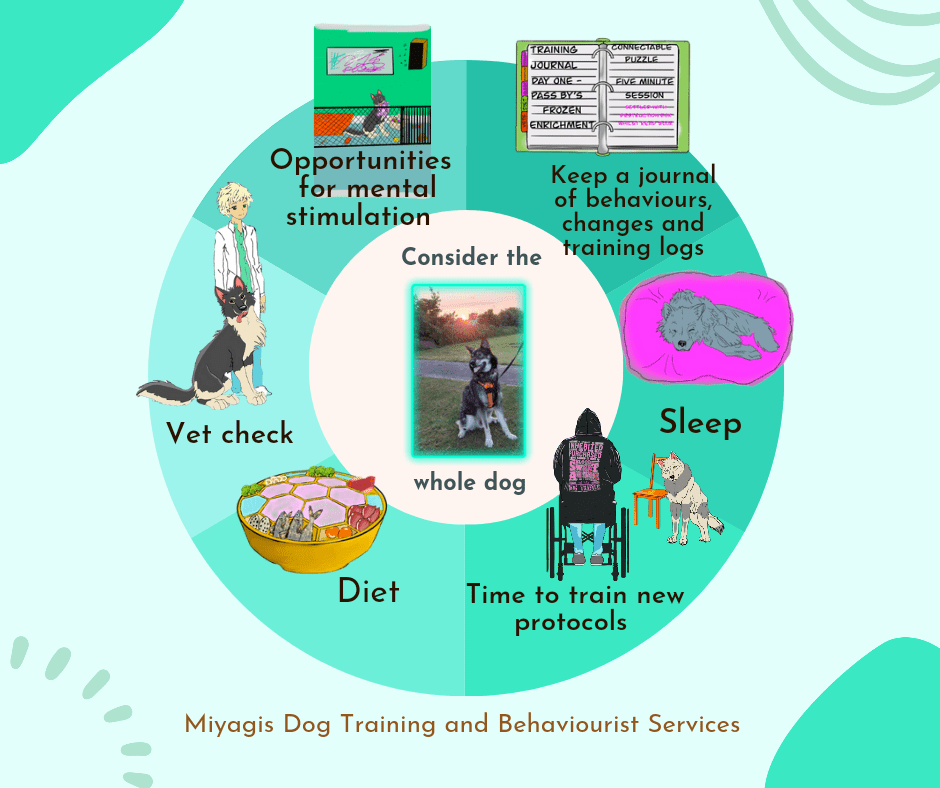
A Wheelchair user with their back to the screen playing the chair game with a cream and grey wolfdog with the category title of “Time to train new protocols.”
A category called “diet” with the sodapup honeycomb slow feeder with raw food in the centre with vegetables, fish, liver and eggs in the outer of the bowl.
A Vet with blonde short hair, white medical coat and green scrubs stood with a dark grey and tan Wolfdog with the category “vet check”.
A category called opportunities for mental enrichment with a dark grey and tan Wolfdog behind an xpen fence, within a Doggy Enrichment Land. A green wall with the bottom of a picture frame and a music speaker. There is a destruction box filled with balls, a Kong, a lickimat, a snuffle mat, an orange bed, a bone, an ostrich twist and a loose ball.
The last category is “Keep a journal” with a lined journal with green edges and rainbow dividers.
Time to train new protocols
Many people want to rush training and when searching for a trainer or behaviourist, the criteria and aim for the dog owner (guardian) is not quality of the service but rapid behaviour change. In a lot of cases the dog has had a lot of rehearsal (repeating of the behaviour). This is based on a very small number of people compared to the people who do want quality over quick changes.
The techniques commonly used in dog behaviour modification (changing dog behaviour or training) are habituation, extinction, desensitisation, counter conditioning, response substitution and shaping. Flooding is not used as it can make behaviour worse and although punishment can be used successfully, punishment is not always used correctly. Landsberg, G. M. (2023)
I will describe these key words in detail and the mechanics in a further blog. For now I will briefly explain these keywords in a basic way.
Habituation, is when the dog becomes sensitised to a stimulus such as a hoover, car alarms, etc.
Extinction is when a reward is removed, where there may previously have been a reward for the behaviour. For example, many dog owners (guardians) are worried that by giving their dog comfort within separation anxiety behaviours and going to them and giving them treats that they are rewarding the behaviour and sometimes dog owners (guardians) are told to allow the dog “to cry it out” believing that this will cause extinction of the behaviour. We don’t recommend extinction.
Desensitisation is when you may have a dog reactive dog and whenever they see a dog they have previously become very stressed, so by moving as far away from the trigger as possible and your dog isn’t reacting from a safe distance but can still see the dog in the distance, this would be a form of desensitisation.
Counter conditioning is when we find something that our dog loves such as a really high value treat or toy and when we use this high value item to help our dog to change their emotional response to a trigger. This can be paired with desensitisation, so we want the dog to be below threshold (not stressed), we deliver the high value item to help dog’s to change their emotion towards the trigger (the thing they find scary or stressful).
Response substitution is when your dog is trained to give a new behaviour for a behaviour you don’t want, for example jumping up.
Shaping is when we teach our dog a new behaviour and reward them for each incremental step towards the end behaviour, roll over is a great example of shaping in small steps.
Flooding or you may know this as the term “sink or swim” is an unpleasant experience for dogs where they are exposed to the trigger that scares them or causes them stress for a period of time, the trigger cannot reach the dog being flooded but of course the dog doesn’t know this. It’s a horrible technique and one that can happen by accident for example a rescue dog is rehomed and the full history isn’t available and the new dog owners (guardians) take the dog to a dog event and the dog is exposed to lots and lots of dogs and cannot escape.
So now we understand all of these terms that are often used in dog training and behaviour modification, what does this mean?
Every single dog is an individual and no two dogs from the same litter, parents or household will be the same. Each dog is as unique and as individual as a human! Working with dogs as individuals means that the dog needs to be looked at as an individual and how they can be helped as an individual. Your routine, lifestyle, diet, behaviour and quirks will be very different from another dog owner. Because we are all different and unique.
Breifly looking back in the series, sleep, keeping journals and vet checks are all an integral part of helping you and your dog holistically (this means to not only look at your dog and yourself as individuals but your connections and relationship and the emotional life of your dog).
Some dogs struggle around humans and because dogs live with humans this can be problematic, the dog begins to associate humans with fear and anxiety. Dogs begin to anticipate fear and anxiety feelings when around a human performing certain actions, this can cause chronic stress in dogs and due to wanting to escape the situation can result in a bite. So both the human and the dog are at risk in this situation which can lead to a breakdown in the relationship between the dog and the dog owner (guardian). Van Herwijnen, I.R.; van der Borg, J.A.M. et al. (2018)
This is just one example but in a lot of cases where there is unwanted behaviour from a dog, dog owners (guardians) are stressed, emotional, overwhelmed, feel lost and want the stress to be over. That’s a completely normal reaction to a stressful situation because who wants to have a stressful life? Not us and not the dogs. (Look back to the brain post below this series).
When this happens or you contact us we then set up a behaviour modification plan, once we have gathered all of the information we can then begin to form a modification plan to help.
This can include teaching dog owners (guardians) of dog body language, observation and skills and good dog body language observation skills are crucial for the human and dog relationship and an explanation of why the dog could be showing these behaviours and explaining stress, fear, anxiety and other components contributing to the dogs behaviour. Monteny, J., Moons, C.P. (2020)
We then explain how to reduce the stress for the dog as some situations may not have been considered or been noted as to the stress that the dog is exposed to and which protocols that are being discussed that the dog owner (guardian) feels comfortable with and that they think that they can implement. As well as education for owners in anticipation of problems that could arise and awareness that the more that anxiety is reduced the more that the dog can learn due to anxiety impairing learning. Mills, D.S.; Karagiannis, C et al (2014).
In order to help the dog we need to help the dog owners (guardians) and in some cases dog owners need extra support in a form of counselling to be able to move forward in a positive way and with enthusiasm with the behaviour modification plan.
We also need to make dog owners (guardians) aware that by taking measures for changes that we can set the dog up to succeed and of course changing the home or adapting to a new routine can take time.
This is why we give you time to adapt to your new routine and give time for both you and your dog to make progress, this also enables the dog owner (guardian) to make notes in their journals and we can narrow down particular behaviours or anxiety instead of generalised anxiety.
There is no time scale we can promise to work to as all dogs are individuals, some dogs will take longer to work with than others just like humans in therapy because we are wanting to change the emotion attached to the behaviour or we want to ensure that when modifying a behaviour not only is it modified properly but ensure that trouble shooting methods are in place and that follow up support is given.
Some dog owners (guardians) are in training or behaviour modification for the entire life span of their dog, which is absolutely fantastic as the dog will have an amazing support network and learning opportunities.
There is no shame in remaining in training or needing behaviour modification support just like humans who need regular therapy for the entirety of their lives.
Setting the dog owner (guardian) up to succeed and supporting them will only enhance your skills and make you more knowledgeable and aware of not only your dog’s needs now, but future dogs, how amazing is that!
References
Landsberg, G.M. (2023) Normal social behavior in dogs – dog owners, MSD Veterinary Manual. MSD Veterinary Manual. Available at: https://www.msdvetmanual.com/dog-owners/behavior-of-dogs/normal-social-behavior-in-dogs (Accessed: January 23, 2023).
Van Herwijnen, I.R.; van der Borg, J.A.M.; Naguib, M.; Beerda, B. Dog ownership satisfaction determinants in the owner-dog relationship and the dog’s behaviour. PLoS ONE 2018, 13
Monteny, J. and Moons, C.P. (2020) “A treatment plan for dogs (canis familiaris) that show impaired social functioning towards their owners,” Animals, 10(1), p. 161. Available at: https://doi.org/10.3390/ani10010161.
Mills, D.S.; Karagiannis, C.; Zulch, H. Stress-its effects on health and behavior: A guide for practitioners. Vet. Clin. N. Am. Small 2014, 44, 525–541.




Leave a Reply