

Text to speech audio: https://youtu.be/GGmzjULynEg?si=qpnPH5YiXP44KmED
🍪 Positive reinforcement: it’s the gold standard in modern dog training—or so we’re told. But what happens when the very term that represents kindness, science, and ethical training gets co-opted by punitive trainers? Do we abandon it altogether? Do we toss out the quadrants and the language of behavior science just because it’s being misused?
🐺The Problem: A Wolf in Sheep’s Clothing🐑
It’s not uncommon to see trainers who use harsh methods claiming to “use positive reinforcement.” They might advertise “balanced training” or sprinkle in terms like “reward-based” while still relying heavily on punishment tools like prong collars, e-collars, and intimidation tactics.
The confusion isn’t just frustrating—it’s dangerous.
Guardians who want ethical, compassionate training for their dogs may inadvertently end up in the hands of someone who’s anything but. When positive reinforcement gets misrepresented, it loses its meaning, making it harder for ethical trainers to stand out.
🗯️Do We Need a New Language?
The idea of ditching the language of positive reinforcement altogether has been floated by some in the dog training community. After all, if the terminology is being hijacked, maybe it’s time to find a clearer, more unique way to communicate. But does that really solve the problem?
Here’s the catch: The misuse of a term doesn’t change its validity. Positive reinforcement is a scientific principle, not a marketing slogan. Throwing it away because others misuse it would be like giving up on the word “organic” just because some companies greenwash their products.
Instead of abandoning it, we need to reclaim it.
♻️Reclaiming Positive Reinforcement🍪
How do we take back positive reinforcement from those misusing it? Here are a few ideas:
📚Educate the Public🧠
It starts with teaching dog guardians what positive reinforcement truly means. Explain that it isn’t just handing out treats; it’s about changing behavior by making good things happen when the dog does something right. Highlight the absence of fear, pain, or intimidation.
Encourage guardians to ask trainers specific questions like:
❓“What tools do you use?”
❓“What happens when the dog makes a mistake?”
❓“Can I observe a session before committing?”
📢Call Out the Misuse📢
Without being confrontational, ethical trainers can address misinformation head-on. Write blogs, create videos, or post social media content that debunks myths about positive reinforcement and exposes what punitive trainers are really doing.
🐕🦺Emphasize the Dog’s Experience🐾
The heart of positive reinforcement isn’t in the quadrant; it’s in how it feels to the dog. Ethical trainers prioritize the dog’s emotional well-being, safety, and ability to learn without fear. Focus on these outcomes when discussing your methods.
🧬Evolve the Language🧬
While we don’t need to abandon the term, we can expand how we talk about training. Words like collaborative care, relationship-centered training, or force and fear-free teaching might better capture the depth of what positive reinforcement training truly offers.
❎What Quadrants Don’t Tell You🚫
Another reason punitive trainers can claim to use “positive reinforcement” is the limitations of the operant conditioning quadrants themselves. The quadrants are a framework for understanding behavior change, but they don’t reflect ethics, emotions, or intentions.
For example, someone using positive punishment (e.g., applying a leash correction) might also occasionally reinforce behavior with treats. Technically, they’re using positive reinforcement—but that doesn’t make their overall approach ethical.
This is why quadrants should be seen as tools for understanding behavior, not moral guidelines. Training is more than science; it’s about empathy and respect for the learner.
🚮So, Do We Throw It in the Bin? 🗑️
Absolutely not. Positive reinforcement works—it’s kind, effective, and backed by decades of science. But we need to protect its meaning and ensure guardians understand what it truly involves.
Let’s reclaim the narrative. Let’s focus on educating, clarifying, and standing firm in our commitment to ethical, compassionate training. Positive reinforcement isn’t just a term; it’s a philosophy of care.
🧡And that’s worth fighting for🩵
#dogs #dogtraining #dogtrainingtips
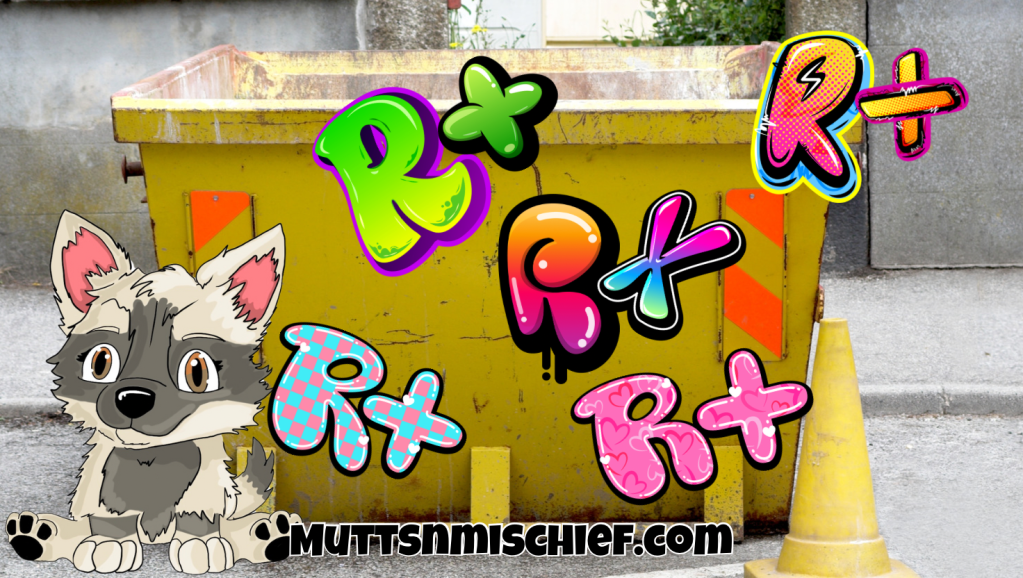
ALT text: The image features a yellow industrial dumpster with worn paint and two reflective orange and white safety signs on its sides. A yellow traffic cone stands in front of it. In the foreground, a cartoon-style illustration of a small, fluffy wolfdog with tan, black, and white fur sits with its paws stretched out. The dog has large, expressive brown eyes, perked-up ears with pink inner coloring, and a friendly expression.
Surrounding the dumpster and dog are multiple “R+” symbols in various graffiti-style fonts and colors, including green, blue, pink, red, and orange. These letters are stylized with different textures and outlines, giving them a vibrant, eye-catching look.
At the bottom of the image, the text “MUTTSNMISCHIEF.COM” appears in bold, black font with a white outline, standing out clearly against the background.

 Mutts 'N' Mischief
Leave a comment