

It’s frustrating to see large, commercially-driven pages resorting to inflammatory language to sell their products or services. Phrases like “Your dog sucks at walking” may grab attention, but they come at a cost—they chip away at the bond between you and your dog.
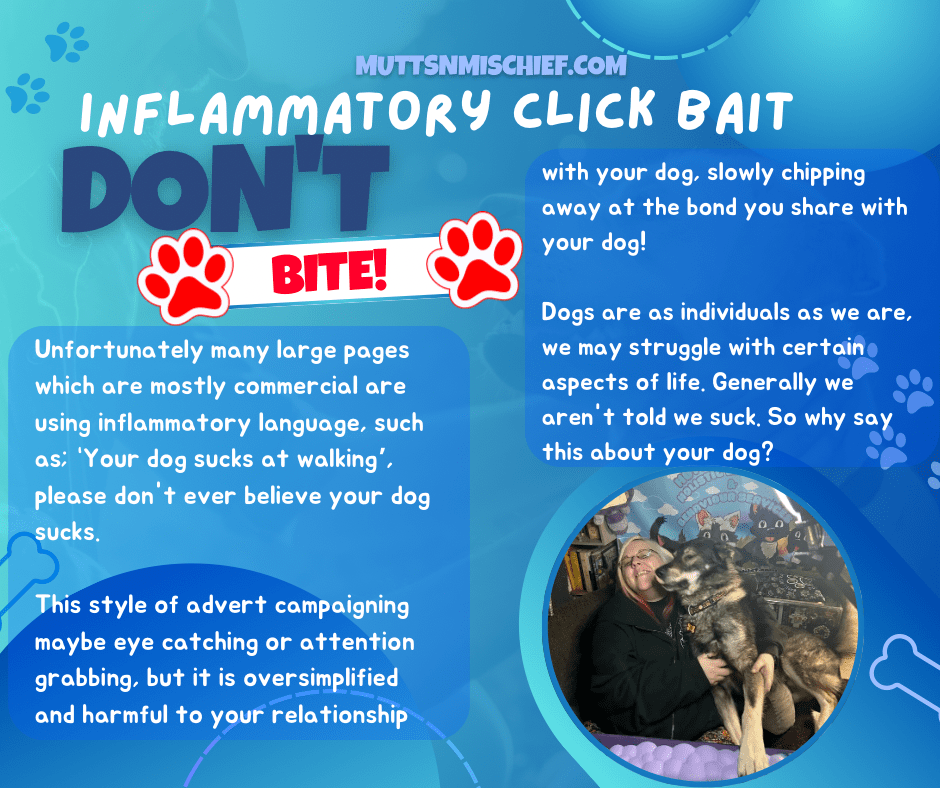
“Graphic titled ‘Inflammatory Click Bait – Don’t Bite!’ from muttsnmischief.com. The background is a gradient of blue with dog paw prints and bones. On the left, a blue text box reads: ‘Unfortunately, many large pages which are mostly commercial are using inflammatory language, such as: “Your dog sucks at walking.” Please don’t ever believe your dog sucks. This style of advert campaigning may be eye-catching or attention-grabbing, but it is oversimplified and harmful to your relationship.’ On the right, text reads: ‘With your dog, slowly chipping away at the bond you share with your dog! Dogs are as individual as we are. We may struggle with certain aspects of life. Generally, we aren’t told we suck. So why say this about your dog?’ Below the text is a circular photo of a smiling person hugging a large dog on a couch, surrounded by colorful decor and a dog-themed backdrop.”
Let’s be clear: your dog doesn’t “suck” at anything. Dogs aren’t born knowing how to walk politely on a leash, respond to cues, or adapt to human expectations. These are learned skills, and every dog learns at their own pace. What’s often labeled as “bad behavior” is simply a dog communicating, exploring, or even struggling with something deeper, like fear, frustration, or discomfort.
Some advice from these pages also oversimplifies the reality of training. For example, holding out a spoon of peanut butter isn’t a magic wand to make your dog walk perfectly on a leash. Sure, it might help in some situations, but lasting success comes from understanding your dog’s emotions, motivations, and the reasons behind their behavior.
Effective training takes time, patience, and consistency—not quick fixes.
Using language like “your dog sucks” reinforces feelings of guilt and frustration for guardians. It paints your dog as a problem to be fixed rather than a companion who needs guidance, patience, and understanding. The truth is, training and behavior challenges are opportunities to strengthen your relationship, not proof of failure.
So next time you see a flashy ad claiming your dog is doing something wrong, remember: your dog isn’t “bad” or “broken.” They’re just trying to navigate the world with the tools they have—and it’s our job to help them. Instead of criticism, let’s focus on building trust, teaching with kindness, and celebrating progress, no matter how small.
Your dog isn’t failing. They’re learning—and so are you.

 Mutts 'N' Mischief
Leave a comment