Text to speech audio link – https://youtu.be/7JaSUyySVrg?si=eqVvhGRy71yq8EEd
This will be a mini series of weekly blogs, to create a true understanding and to give as much information as possible.
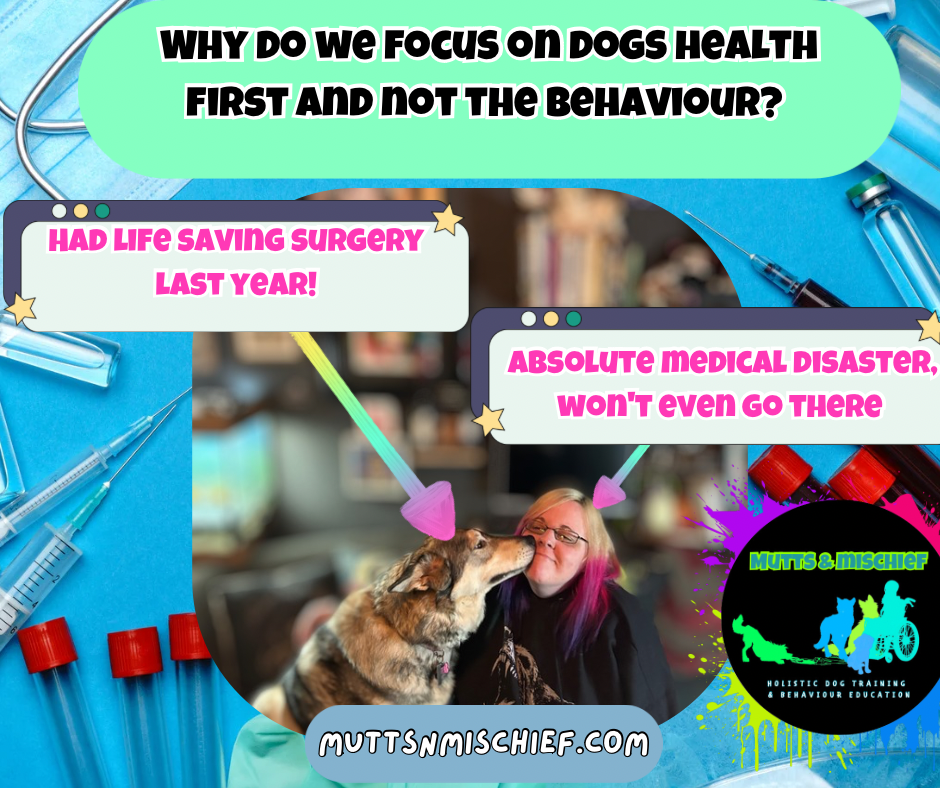
If you work with a behaviourist the very first question should be have you had a veterinary check. Which details what the vet check should have explored. This will also be within your behavioural consultation pack prior to the appointment.
A Vet check with an integrative vet can ensure that there is nothing going on medically, and that there is no pain causing the behaviour that you are struggling with. This will help to narrow down the why of the behaviour and help the dog with triggers or in beginning the journey of identifying the why of the behaviour.
We highly recommend a Vet check with an integrative vet to ensure that there is nothing going on medically and that the behaviour you are struggling with is behavioural and not medically related as pain is fluid and vets tend to simply look at isolation pain and not chronic pain or unwellness. An integrative vet will see your dog as an individual and do a blood panel, possibly a pain trial and ask you lots of questions to get a better picture. Recording videos of your doga movements and behaviours can also be a great starting point for the vets.
Just as we respect individuals with invisible disabilities we should also respect that we don’t know what is going on internally within our dogs bodies.
Not all invisible conditions cause symptoms that we can see such as vomiting, changes in stools, limping, lethargy. During the chronic pain symposium – the ‘Prevalence of radiographic appendicular oa and associated clinical signs in young dogs’ with – Dr. Duncan Lascelles, I witnessed a dog from his study of a year old dog with arthritis in comparison to an older dog with arthritis both going up a set of steps. The older dog showed physically signs of struggling, the young dog did not but to their trained eyes an altered gait.
Another research paper looked at the impact of unwellness in dogs of all ages and the impact on owners and found that the owners of elder dogs were resigned to their dog becoming arthritic whereas owners of younger dogs couldn’t believe it as they didn’t see any obvious symptoms. (1)
This is why it is so important to seek out an integrative vet who will spend a good amount of time with you and your dog, observe their movements and want to know every detail about your dog to make a diagnosis or clear them. Which I will expand on in the next part of the series.
I just created a post about how to find an integrative vet as unfortunately most do not have their own practices and tend to work in a traditional vets with allopathic medicine. Allopathic medicine is pharmaceutical based medication for those who don’t know.
Being holistically based, if you find yourself working with a holistic practitioner we prefer to work within an integrative team, so the other professionals within the team maybe wholly holistic such as hydrotherapy, chiropractors, physio, acupuncture but the vet will most often be integrative. We acknowledge that conventional medicine has its place but so does holistic.
Reflect for a moment if you still don’t quite understand holistic, whichever dog food you feed whether you are BARF die hard or a kibble connoisseur most likely now in your cupboard will be salmon oil, some form of herbal supplements. You may also use Pet Remedy and Dorwest herbs for problems you feel confident in handling yourself.
Until the industrial revolution in the 1800’s pharmaceutical was the snake oil, until Beechams became popular in the mid 1800’s, we didn’t have aspirin until the early 1900’s and until the first and second world war there was no insulin or penicillin.
In 1957 this is when the NHS in England as we kind of know the shell of the original NHS, wasn’t entirely built so the poor could afford healthcare as was the original purpose. But to fund the exciting new world of pharma. (2)
In the early 1900’s the idea was to close medical schools which did not jump into pharma and still focused on herbal medicine as pharma was discovered as the cash cow. By the 1930’s there were no more medical schools that could teach unless it was pharma based.
Herbalist’s have been famous throughout history and also key people from ancient times to now such as Hippocrates. The hippocratic oath is recited by medical professionals still today!
Herbal medicine has also played a vital role in many cultures and for the empowerment of women too, which Hollywood coined and turned into snake oil peddling. All sorts of clever techniques will be used by capitalists to make cash fast.
The last homoeopathic school in the US closed its doors in 1920 because all of the medical students wanted to work with the exciting and revolutionary new pharma. However in the 1970s only 30 years after the boom of pharma going mainstream, homoeopathy made a comeback.
Sadly like the dog training industry pre 1970s many people turned to homoeopathy because like dog training there were no regulations and anyone could set up as a homoeopath and peddle snake skin oil and liver pills.
This all changed with one doctor called Dr. Samuel Hahnemann of Germany. From studying on himself he quickly found that medicating a well person could cause the symptoms of unwellness to a lesser degree and used the cowpox vaccination to cure smallpox with the famous term “like, cures like” or “Principles of similars.” (3)
When the 1950’s began to see a revival in herbalism as soon as big drug companies realised this was another way to grab another section of the market they did that too, but had to now convince people it wasn’t quackery and also they have decimated many plants and endangered species as well as contributed to species becoming extinct in the name of greed.
The European Union brought in new measures to decree that herbal medicines had to meet similar criteria to that of pharma medicines in 2011. (4)
So holistic doesn’t necessarily mean herbalism and plants all the way or hoodoo, as it is sometimes referred to as. Herbalism is deeply rooted in science because it has had to prove it’s worth to come back into circulation alongside pharma.
Holistic means an individualised focused approach to that one individual working within a multidisciplinary team, sure there maybe herbalists or aromatherapists involved or even elements of zoopharmacognosy elements because animals teach us so much about their needs through their own self selection both in the wild and domestic settings.
So this is why we rely on integrative vets, they have studied the path of pharmacy first, become qualified, practised and become seasoned and then evolved into their own practitioner based on their scientific learning. You can hear this directly from an integrative vet herself here following the link! https://canineflow.com/insights/how-to-find-a-holistic-vet-in-the-uk
References
Belshaw, Z., Dean, R. and Asher, L. (2020). ‘You can be blind because of loving them so much’: the impact on owners in the United Kingdom of living with a dog with osteoarthritis. BMC Veterinary Research, 16(1). doi:https://doi.org/10.1186/s12917-020-02404-5.
Pharmaphorum (2020). A history of the pharmaceutical industry. [online] pharmaphorum. Available at: https://pharmaphorum.com/r-d/a_history_of_the_pharmaceutical_industry.
Loudon, I. (2006) A brief history of homoeopathy, Journal of the Royal Society of Medicine. U.S. National Library of Medicine. Available at: https://www.ncbi.nlm.nih.gov/pmc/articles/PMC1676328/
Anon, (n.d.). Legislation | British Herbal Medicine Association. [online] Available at: https://bhma.info/legislation-on-herbal-medicines/#:~:text=Traditional%20Herbal%20Registrations%20(THRs)

 Mutts 'N' Mischief
Leave a comment