Change the world for one dog
Audio link – 8 mins 40 secs https://youtu.be/3vYhLr0e3SU?si=1Z_Ep-Z9TaOL8Uz2
This will be a series of blogs as it is just far too long to keep to one blog.
As someone with compassion fatigue I wanted to explore this and how both we as professionals and guardians can do better. I believe the solution is that people begin to see the care of dogs as the same standard of care for a child.
Many people strive to be the best parents that they can be and will find someone that they look up to, to guide them through this journey whether that’s parenting books or television shows. When people find out that this person was actually sharing harmful information, parents are understandably upset by this.
I see the same in the dog world, harmful information is more rife now than ever before, we aren’t just fighting against television but also YouTube and all social media channels. We aren’t just guiding guardians away from rubbish on Google, but trying so hard to protect them from every angle that is harmful.
Many guardians believe that they are doing everything correctly and they actually probably are doing their absolute best. How do I know this beyond opinion? Good question. Good old research and journals. Viewing this cross sectionally as I feel this is really important, I will be looking at two papers specifically, one from 2019 (pre TikTok and covid) and one from this year.
Animal Welfare is complex and those of you who follow my posts know that with the Animal Welfare Act 2006 just how complicated this really is. We know that there are huge failings for animals all across the world but specifically the UK which doesn’t police its own laws, but I digress.
So the 2019 paper (1) expresses that dog welfare is multifaceted and multidisciplinary, there are so many factors to take into account when exploring this subject such as economic, scientific, psychological, biological, philosophical, social, cultural, political as well as consequential. (2)
There are so many things to consider when bringing a dog into your life. As can be seen by the photo of Koda and Diesel, once upon a time (5 years ago) I wrote out a hypothetical budget for the cost of a puppy or dog. This would be three times the amount now.
Back in 2019 it was estimated that 26% of the population shared their home with a dog. We now know how much this has increased post covid to double this amount standing now at 53% of the population across the UK.
As I explored in my Five freedoms blog series we can see how difficult it truly is to define good welfare standards, as we saw when animal welfare was becoming a need in the UK that the paradigms were very different to what we see today where it is now accepted that dog welfare should be viewed with a scientific approach as a measure of the welfare standards.
Veterinary care was an easy tool for researchers to use as a measure of dog welfare standards as this can be seen by statistics, measured and observed objectively. The second way to learn about dog welfare is through neuropsychological approach and the third being the dog’s affective state. Welfare is not something that can be done to someone but is a state of being.
If a dog enjoys a positive state of welfare it is generally considered that all three aspects of the welfare considerations are applied to ensure the dog’s positive welfare status. (4)
Animal Welfare and companion dog psychology are relatively new sciences that are also not fully understood clearly. It is also viewed as disordered and lacking boundaries too. Which makes it complicated mixed with the philosophical considerations of what truly constitutes good animal welfare. Especially as dogs are unfortunately seen as how they benefit society and humans. (5)
Unbelievably there is extensive guidance on dog welfare specifically for charities, councils and the law to best advise guardians how to care for dogs but sadly as we see with most things this is due to being produced by those who have a stakeholder in dog welfare. So it can be argued that there is much evidence out there for education for dog guardians and it has been argued that dog guardians simply disregard this information and learning resources. (6)
However as a behaviourist I would in fact argue that information is not readily available and is in fact gate kept. I know this as fact, many journals and peer reviewed papers we have to pay a considerable amount of money for. They are also not user friendly for everyone, being in battle with one currently for not being user friendly for neurodivergent readers.
We also know this from my previous post referencing the policing laws for the UK concerning dogs which you can read here. 📸 Look at this post on Facebook https://www.facebook.com/100057373879884/posts/740670534522069/?d=n&mibextid=WC7FNe
It has also been argued that schools have a duty of care to teach animal welfare as a part of the curriculum. (7) However we know that the Animal Welfare is simply not policed nor governed unless in the most tragic and awful of cases, where animals have to come to extreme harm before anything is done.
References
Philpotts, I., Dillon, J. and Rooney, N. (2019). Improving the Welfare of Companion Dogs—Is Owner Education the Solution? Animals, [online] 9(9), p.662. doi:https://doi.org/10.3390/ani9090662.
Bayvel A.C.D., Cross N. Animal Welfare: A Complex Domestic and International Public-Policy Issue—Who Are the Key Players? JVME. 2010;37:3–12. doi: 10.3138/jvme.37.1.3.
Yeates J.W., Main D.C. Veterinary surgeons’ opinions on dog welfare issues. J. Small Anim. Pr. 2011;52:464–468. doi: 10.1111/j.1748-5827.2011.01095.x.
Fraser D. Animal behaviour, animal welfare and the scientific study of affect. Appl. Anim. Behav. Sci. 2009;118:108–117. doi: 10.1016/j.applanim.2009.02.020.
Belshaw Z., Asher L., Harvey N.D., Dean R.S. Quality of life assessment in domestic dogs: An evidence-based rapid review. Vet. J. 2015;206:203–212. doi: 10.1016/j.tvjl.2015.07.016.
PDSA PDSA Animal Wellbeing (PAW) Report 2016. [(accessed on 23 August 2019)]; Available online: https://www.pdsa.org.uk/get-involved/our-campaigns/pdsa-animal-wellbeing-report/past-reports
RSPCA Call for Animal Welfare in Education. [(accessed on 28 August 2019)]; Available online: https://www.rspca.org.uk/whatwedo/education/action
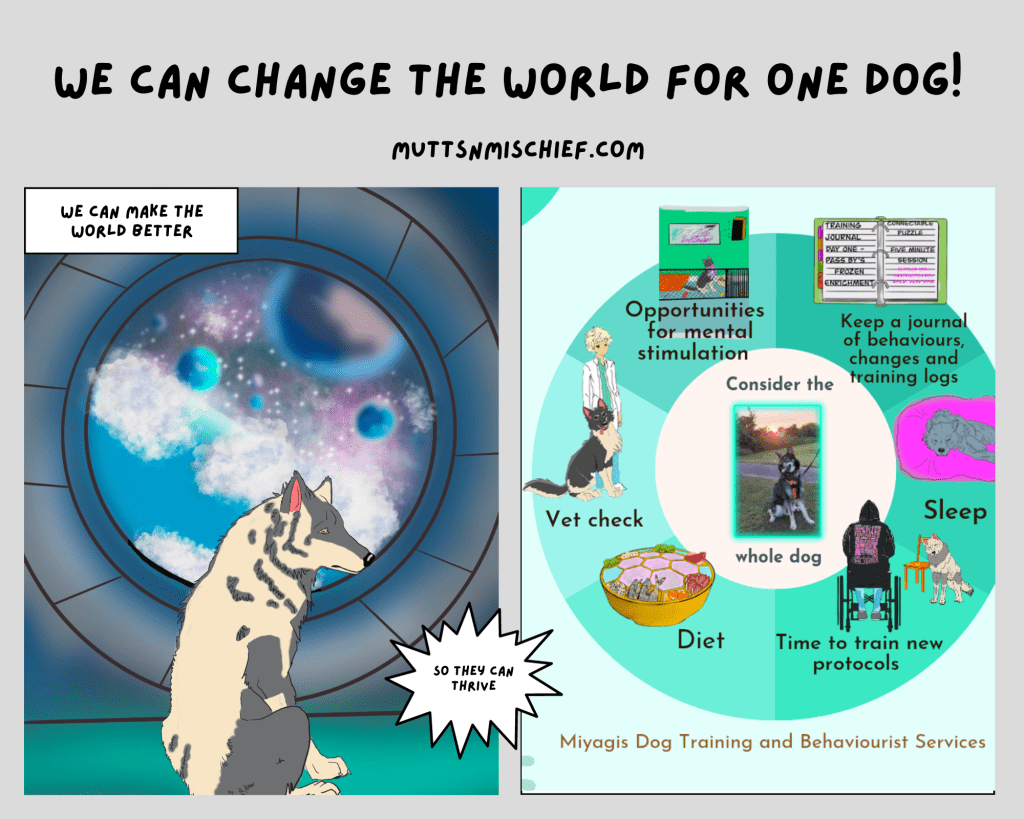
Image description: A grey comic book panel with two windows. The title is “We can change the world for one dog” underneath the subtext says muttsnmischief.com
The first window is of a grey and cream Wolfdog sitting on a spaceship looking out of the window at the galaxy and different planets. But looking back into the ship with her head over her shoulder.
Second window: a mint green background with a shaded green category circle. Within the categories are sleep, with a grey wolf dog sleeping on a pink bed.
A Wheelchair user with their back to the screen playing the chair game with a cream and grey wolfdog with the category title of “Time to train new protocols.”
A category called “diet” with the sodapup honeycomb slow feeder with raw food in the centre with vegetables, fish, liver and eggs in the outer of the bowl.
A Vet with blonde short hair, white medical coat and green scrubs stood with a dark grey and tan Wolfdog with the category “vet check”.
A category called opportunities for mental enrichment with a dark grey and tan Wolfdog behind an xpen fence, within a Doggy Enrichment Land. A green wall with the bottom of a picture frame and a music speaker. There is a destruction box filled with balls, a Kong, a lickimat, a snuffle mat, an orange bed, a bone, an ostrich twist and a loose ball.
The last category is “Keep a journal” with a lined journal with green edges and rainbow dividers.

 Mutts 'N' Mischief
Leave a comment