Cat chasing
Many guardians struggle with having an interspecies household and or their puppy or dog chasing cats.
Interestingly Researchers found that puppies under the age of 12 weeks introduced to a cat within the same household, showed the typical over exuberance of a puppy instigating play and chasing. We have to understand that our dogs, no matter how young, have instincts that they are born with and you cannot punish instincts out of them, no matter how much one may try.
A survey of 3155 respondents was conducted and 7% of the homes had both a dog and a cat within the home. (1) Another survey had 648 respondents who had both a dog and a cat within the home. (2)
Within this study of the respondents 82.9% felt their cat was comfortable with sharing their home with a dog and 91.2% felt that their dog was comfortable sharing their home with a cat. However when asked about the specifics of the relationship they found that of the respondents 20.5% of the same cats were uncomfortable with the dog ranging from one day to seven days in a week and 7.3% of dogs showed uncomfortability with the cat between one day per week up to seven days per week.
56.5% of the cats had threatened the dog and 9.6% caused injury to the dog.18% of the dogs were reported to have threatened the cat and only 0.9% of the dog’s had caused injury to the cats.
It was also found that cats who spent more time indoors as opposed to outdoors seemed to have a better relationship with the dog as reported by the guardians.
This study is interesting in looking at how guardians perceive the relationship between their dog and cat but also report injury and threats.
It is known that both dogs and cats can be relinquished due to aggression towards one another.
Researchers wanted to explore this further and look at how a cat responded to a puppy moving into their home to further understand how to help guardians make the best choices.
1248 puppies were used within the survey. Of this number of puppies 1211 puppies were introduced to the cats but 37 still needed to be introduced to the cat at the time of the survey.
Interestingly these results are what the researchers found from guardian observed feedback.
58.9% of the puppies played.
56.6% of the puppies were over-exuberant.
48.7% of the puppies chased.
23.9% were wary and cautious.
3.1% were nervous or fearful.
1.7% were aggressive.
12.9% expressed no interest in the cat.
28.5% interested in a calm way.
Researchers also investigated further into how introductions were conducted. 448 of the puppies between the ages of 12 and 22 weeks were recorded to be introduced to the cat immediately or quite quickly. 448 of the puppies were reported to show undesirable behaviours and 24 of the puppies were reported to show desirable behaviours. 675 puppies were reported to be introduced to the cat gradually and were reported to show one or more undesirable behaviours, 64 puppies were reported to show desirable behaviours. Puppies under 12 weeks old were reported to have 442 puppies to show undesirable behaviours and 53 puppies to demonstrate desirable behaviours.
Looking into this further they also asked whether the introductions were guardian led, animal led. They found that the guardians who let the puppy and cat set the introduction expecting the puppy to be respectful and the cat to teach the puppy respect were the guardians who reported undesirable behaviours, many guardians accepting their puppy and cat will never be able to share the same space within the home and to be segregated. Whereas the guardians who used management, controlled the environment and introduced them gradually had much more success and lower expectations of both animals. (3)
This is where I am going to end my summisations of the journal and explore the conclusion which the researchers and I are agreed that there has to be more education around dogs and cats and the perceived relationships and expectations on both animals.
History shows that for the last 9,000 years dogs and cats have come together through sharing space of settlements with humans and developing relationships with humans. But as we look at evolution of both the dog and the cat we have to understand that as different species evolution has shaped them independently and not merged together for the union of dogs and cats within the same household. (4)
As professionals we know that there are not only a lot of expectations placed on a puppy but also pressure which can result in punishment and reoccurring punishment over a period of time until the guardian decides to either invest in professional help or relinquishes one of the animals. We have a duty of care to educate guardians that this isn’t OK.
Of course we do when we work with them, however many guardians as can be seen from the statistics above simply think a car should correct a puppy. But what we are seeing with the puppies on a mass scale is the innate desire to chase, play rough, grab and do things that will either get themselves or the cat injured.
Many dogs and cats can and do live together quite harmoniously yet the dog will still attempt to chase or bark at a cat on a walk. Another research paper looked at the desire to chase based on the animation of motion and whilst I’m not going to dissect that paper within this blog it is important to remember that both dogs and cats are predators and not prey animals but for dogs the animation of the cat moving, running, darting activates the need to chase.
We also need to understand that there are 350 formally recognised dog breeds across the world and whilst we may think we share our sofa with an adorable furry gentle teddy bear ( you aren’t far wrong) but we do have to be mindful that dogs were not originally bred to be companions in the sense that they are today but we’re artificially selected in breeding programmes to have an intense prey drive, stalking, herding behaviours etc.
Over 9,000 years we can see that dogs and humans have coexisted and we know that in the last few hundred years of confirmed breeding and artificial selection. However professional breeders who breed for breed traits are not seeking to extinct unwanted behaviours from guardians, working dogs are still very much a part of society today across the world and breeders want to breed the best of the best, this will include their breed and genetic distinctive gene traits which makes them that specific breed.
We have to fully understand the dog we share our home with as the individual that they are, be respectful and mindful of their genetics and ancestry in order to have a wonderful bond and cohabitation relationship with them. Placing human ideals onto animals simply will not work, a dog cannot help to chase other animals as much as a bird cannot help to sing.
Instead we have to look at how we can communicate with our individual dog(s) , find what makes them tick, build our value to them so they want to see what we have. We need to respect their genetics and allow them to eye stalk, we have to utilise long lines and be sensible about the parameters of our dogs behaviour. If you have no recall especially around smaller animals or livestock use a long line to keep your dog and other animals safe. Work on communications and games to work with your dog as the species that they are. But don’t place unrealistic goals and expectations on dogs and puppies. It isn’t fair to them and you are just setting yourself up to fail.
If you would like to learn more I highly recommend these books:
The Do No Harm Dog Training and Behaviour Handbook by Linda Michaels MA: https://amzn.to/3PhC74z
Hunting Together by Simone Mueller: https://www.amazon.co.uk/dp/1659254124/ref=cm_sw_r_apan_glt_fabc_1P829Z96K8C7X42TVMB8
Control Unleashed by Leslie McDevitt: Control Unleashed Reactive To Relaxed https://amzn.to/3oAr5LN
Original Rocket Recall by Lisa Lyle Waggoner: https://amzn.to/3bi5Awp
And of course there are lots and lots of free tutorials on our YouTube channel to help you. Here and some to get you started:
Remember dogs and puppies are a beautiful species we choose to share our home with and we have to remember that their genetics will dictate much behaviour that cannot be punished!
References
- Murray, J.; Gruffydd-Jones, T.; Roberts, M.; Browne, W. Assessing changes in the UK pet cat and dog populations: Numbers and household ownership. Vet. Rec. 2015, 177, 259.
- Thomson, J.; Hall, S.; Mills, D. Evaluation of the relationship between cats and dogs living in the same home. J. Vet. Behav. 2018, 27, 35–40.
- Kinsman, R.H. et al. (2022) Introducing a puppy to existing household cat(s): Mixed method analysis, MDPI. Available at: https://doi.org/10.3390/ani12182389 (Accessed: 24 November 2023).
- Driscoll CA, Macdonald DW, O’Brien SJ. From wild animals to domestic pets, an evolutionary view of domestication. Proc Natl Acad Sci U S A. 2009;106Suppl: 9971–8. 10.1073/pnas.0901586106
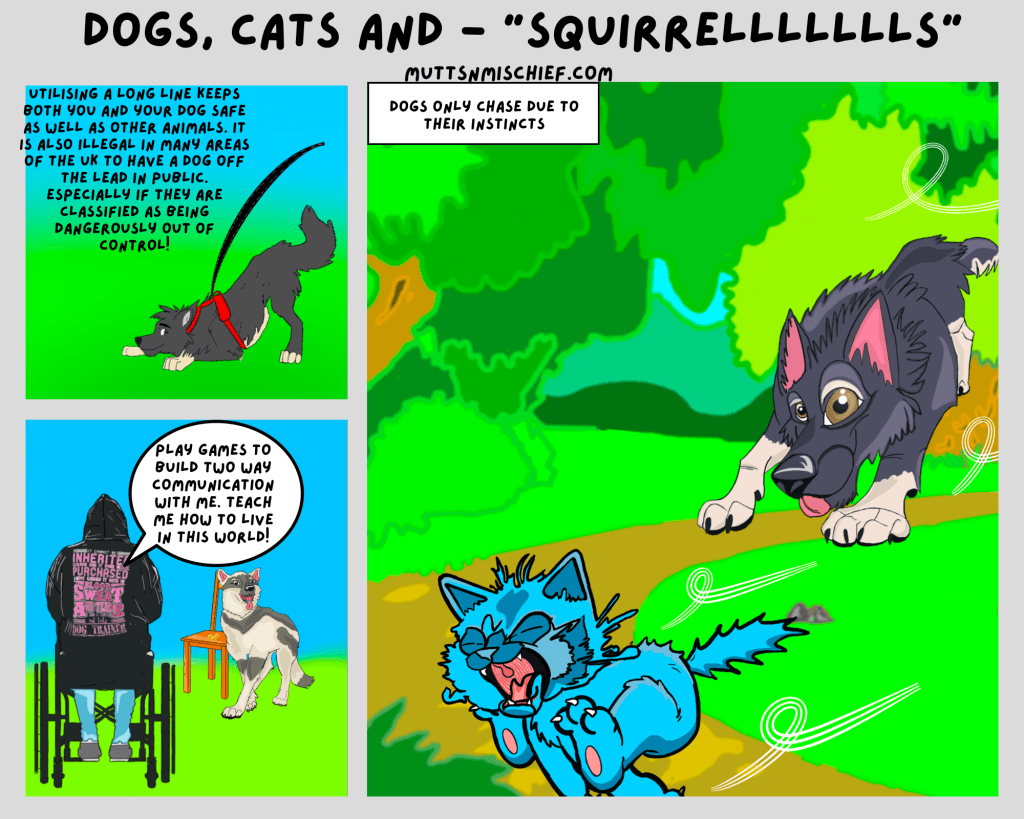
Image description: A three window comic strip titled: Dogs, cats and squirrels.
The first window is of a grey and cream Wolfdog on a lead on a green and blue background to represent the grass and sky. The text reads: Utilising a long line keeps both you and your dog safe as well as other animals. It is also illegal in many areas of the UK to have a dog off the lead in public. Especially if they are classified as being dangerously out of control!
The second window is a Wheelchair user playing the chair game with a cream and grey Wolfdog. The text says: Play games to build two way communication with me. Teach me how to live in this world!
The third window is of a dark grey and cream Wolfdog chasing a blue cat screaming in a woodland. The text says: Dogs only chase due to their instincts.

 Mutts 'N' Mischief
Leave a comment