

The importance of working within a multidisciplinary team for the best care of both the dog and guardian!
The first step is the elimination or inclusion of a diagnosis to move forward for patient centred care.
If you visit my website and go to the contact form, you will see a little extraction from a prior blog on what to expect when you want to book a consultation and I am 100% transparent and state that the first thing I am going to do is ask you to see a Vet. I am and I will. Or we will discuss your most recent vet check. You are also not on your own with this, so like many if you have no idea where to start, I will help you.
Thanks to vet checks, sudden new behaviours have meant that guardians didn’t need me after all because the vet found that the dog exhibited the behaviour due to being unwell. Whilst this may not book me a client it does let that guardian know, first and foremost I care about their dogs health over money and secondly they will and do spread the word that I care solely about the dogs welfare as an individual.
I am now super lucky to be a patient of Lincolnshire vets who have been absolutely amazing, from coming across from other vets, down to what they have done for Koda, as well as truly caring about us both. Now to me this should be a standard with all vets. Vets who listen, work with us, recommend additional services, recognising only the animal patient and their guardian matter.
Working within a multidisciplinary team means I can recommend to a guardian to contact certain professionals and only with permission (because of GPRD) can we then have a discussion on the best way forward for the individual dog with the guardian included in the care plan moving forwards.
For example, working with Bilsby Canine Hydrotherapy, Koda now needs a different care routine in hydrotherapy and we can discuss this thanks to being a multidisciplinary team, with the same goal, Kodas welfare.
“Behavioural problems and physiological medical problems have been treated separately for years, but behaviour depends on an animal’s health and vice versa. Some behaviour problems are caused totally or partially due to medical problems. But this comes with its own diagnostic challenges for vets as apart from behavioural changes there are no other indications of illness. Camps. T, Amat. M, et al (2019)
Something that has encouraged and conversely put some clients off on initial contact is the recommendation of a Veterinary check to establish whether sudden behaviour changes or rescue dogs could be suffering with pain or ill health which has caused the change in behaviour.
When a dog presents with a new behaviour we have to explore all of the changes within yours and your dogs life, whether you have moved home, someone has moved in or out, any surgery, any attacks or incidents, a new dog in the home, sudden periods of separation and much more which could influence behaviour or if there’s anything medically happening.
Dogs are very good at hiding pain and illness, we have to be mindful that no two dogs will show the same behaviours of expression of pain, especially depending on their pain threshold as some injuries or pain may be slow in developing to big gestures of limping or vocalisations. There can be more subtle signs such as changes in pupil dilation, restlessness, changes in appetite or behaviour, increased or reduced physical activity and even a bite from a normally friendly dog.
You may not see any behaviour change at all as we didn’t with Koda, instead her unwellness was physical and could be visually seen.
Some people also think that when we say vet check that we mean a booster appointment for a vaccination.
Instead a Vet check with an integrative vet can ensure that there is nothing going on medically and that this is behavioural and not medically related as pain is fluid and vets tend to simply look at isolation pain and not chronic pain or unwellness. An integrative vet will see the dog as an individual and do a blood panel, possibly a pain trial and ask you lots of questions to get a better picture. Recording videos of the dogs movements and behaviours can also be a great starting point for the vets.
Within another research study researchers found that veterinarians were criticised for not discussing or investigating behavioural problems with dog guardians, so the researchers set up on a fly on the wall approach. 17 consultations were set up with 6 veterinarians, the dog guardians were asked to share their concerns about behaviour which resulted in 58 behaviours of concern across the total and found that only 10 of the consultations out of 58 had been discussed. With the dog guardians having to bring up the topic of behavioural concerns that they had. Roshier, A. L. (2013)
A previous study five years earlier observed wellness appointments and health problem appointments and found that 90% of the conversation focused on the health problem focusing on the biomedical data whereas in wellness appointments, 50% of the conversation is based on gathering information and 27% based on owner education and that due to dogs only going to the vets when unwell or for boosters is the only opportunity to discuss welfare. Shaw.J, et al (2008).
Which as a form of confusion that we find when discussing vet checks with dog guardians makes sense as to why when we ask or recommend a Vet check that dog guardians (guardians) typically tell us that nothing was wrong and or discussed at the booster appointment.
There were also two main barriers found in the question of: “Do you have any concerns?” in that dog guardians felt embarrassed or that the behaviour was trivial and that dog guardians needed a flow of conversation to be able to open up. Robinson. J. D, (2001)
This second part is really important because when we use a client centred approach with dog guardians and help them to feel empowered, more people do talk at ease and even though emotions come up, there is no sense of embarrassment. When we actively listen this helps people to talk, and empowers the dog owner to speak up about how you feel, how behaviour might be affecting you and then we come full circle to how we can help. Because both ends of the leads are equally important.
This study goes onto discuss welfare in dogs and dog guardians (guardians) legal duties under the Animal Welfare Act (2006) which I have discussed before. The study finishes with the conclusion of understanding animal and owner needs for best welfare practice aimed at vets. Short, C. E. (1998)
But all professionals who work with dogs have an ethical duty of care to best inform dog guardians with education on why vet checks are vital and why doing particular things with dogs and meeting their biological needs is so important. This is why we also share a welfare responsibility for dogs who we work with because we need to best support the primary caregiver and families of their dog.
So if your dog is showing changes in behaviour or you have a new dog and you’re worried about some of the behaviours, please don’t be worried about reaching out for help and discussing these worries. Either with your vet or reach out to a behaviourist. You should always be made to feel empowered, valid and supported.
There are no silly questions or concerns, if you are worried about something it’s much better to ask and if you aren’t happy with the answer you can absolutely get another opinion. This doesn’t make you a “Karen or a Kevin” as many people do worry they will quickly become a social media slur and considering people’s feelings and worries as much as we might chuckle at these expressions of names to label someone difficult, the truth is more people dare not speak up when something is bothering them because of silly social media quips.
If you don’t feel you have a good relationship with your vet then you may find that speaking to a Canine Chiropractor, hydrotherapist, physiotherapist more empowering and asking for their evaluation of their professional opinion. This doesn’t mean that they can give a medical diagnosis but they can support you with a specific referral to the vet with specific instructions of what needs to be explored.
Always speak up, always ask questions, your feelings are valid and there is nothing to be embarrassed about and even if you cannot pinpoint how your dog could be ill or in pain, remember they hide pain and unwellness well.
References
Camps T, Amat M, Manteca X. A Review of Medical Conditions and Behavioral Problems in Dogs and Cats. Animals (Basel). 2019 Dec 12;9(12):1133. doi: 10.3390/ani9121133. PMID: 31842492; PMCID: PMC6941081.
Roshier AL, Foster N, Jones MA. Veterinary students’ usage and perception of video teaching resources. BMC Med Educ. 2011 Jan 10;11:1. doi: 10.1186/1472-6920-11-1. PMID: 21219639; PMCID: PMC3025976.
Shaw J. R., Adams C. L., Bonnett B. N., Larson S., Roter D. L. (2008) Veterinarian-client-patient communication during wellness appointments versus appointments related to a health problem in companion animal practice. Journal of the American Veterinary Medical Association 233, 1576–1586
Robinson J. D. (2001) Closing medical encounters: two physician practices and their implications for the expression of patients’ unstated concerns. Social Science and Medicine 53, 639–656
Short, C.E. (1998) “Fundamentals of pain perception in Animals,” Applied Animal Behaviour Science, 59(1-3), pp. 125–133. Available at: https://doi.org/10.1016/s0168-1591(98)00127-0.
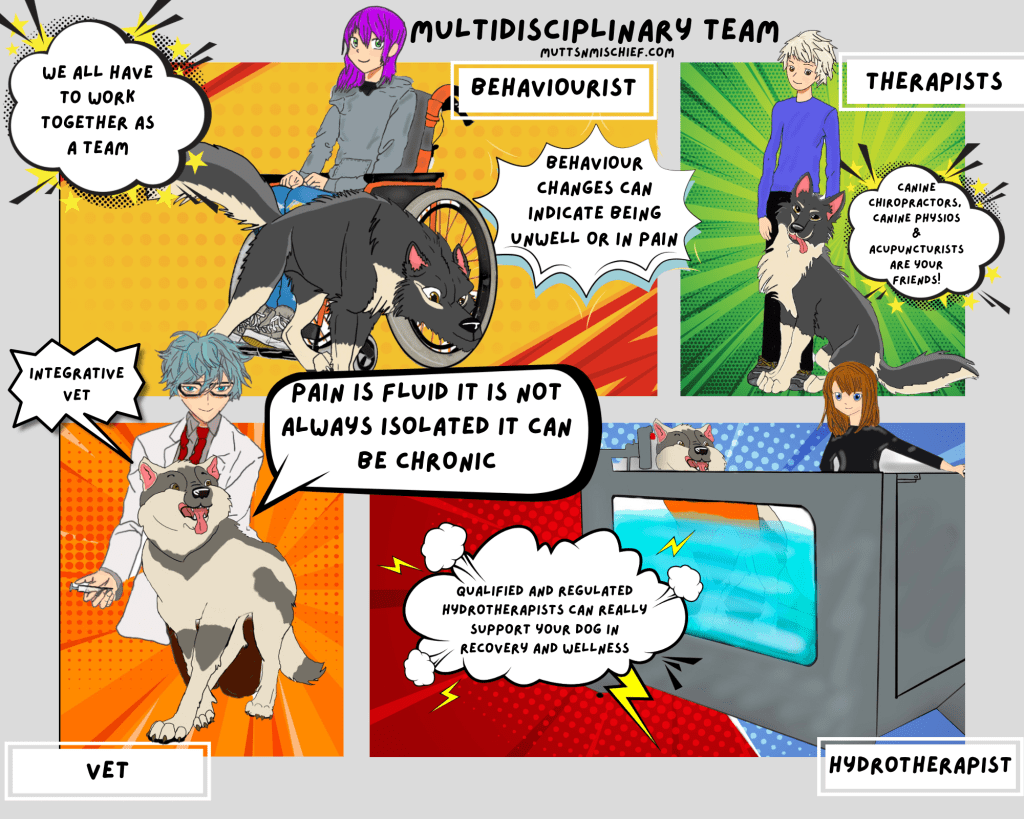
Image description: A grey four window comic strip. Titled on the centre – Multidisciplinary team. Muttsnmischief.com underneath.
The first left window is a Wheelchair user with purple hair with a Wolfdog in front of them with an orange and red background. The text says: behaviourist.
We all have to work together as a team.
Behaviour changes can indicate being in pain or unwell.
The second right window is a man with blonde hair and a blue jumper, standing next to a Wolfdog with a green background. The text reads: therapists.
Canine chiropractors, Canine physios & acupuncturists are your friends!
The third bottom left window is a Vet with blue hair with a red shirt and white doctor’s coat, with a cream and grey Wolfdog. The vet says – Integrative vet.
The text reads – pain is fluid, it is not always isolated and can be chronic.
The fourth right hand window is a Wolfdog in a water treadmill in an orange life jacket. There is a woman in a black wetsuit stood next to her inside the treadmill.
The text reads – hydrotherapist.
Qualified and regulated hydrotherapists can really support your dog in recovery and wellness.

 Mutts 'N' Mischief
Leave a comment